

Everything counts
The last stroke of a hammer breaks a stone

Over the last few weeks, I’ve had multiple people recommend Darren Hardy’s 2010 New York Times and Wall Street Journal bestseller, The Compound Effect.
Although I haven’t yet had the opportunity to read the book, the thesis of reaping huge rewards from small, seemingly insignificant actions has served as a key reflection for me.

I had a professor at Seton Hall (shoutout to you, Dr. Robinson) who continually reminded us that everything is an advertisement about who we are: our brand, values, and disposition to the world. What you say, how you carry yourself, how you interact with others, your nonverbal cues, and what you wear; this all plays a role in shaping who you are and your place in the world.
As soon-to-be graduates and aspiring professionals, this was ever more crucial.
In this vein, every choice you make can spark an avalanche with results five, ten, or even twenty years down the road.
As James Clear writes, “The compound effect is the operating system that has been running your life whether you know it or not.”
So why not take autonomy of it?
Making small changes or correcting habits will often not be noticed at first, even by the changemaker. There might be a layer of shame when you realize how far you have strayed.
But it’s the quiet hustle that makes the loudest impact.
When beginning a journey of self-improvement, doubt clouds the mind. Every setback seems like an unclimbable mountain. You are looking for any excuse to conform to your old ways.
Rome wasn’t built in a day, nor did it crumble in a day.
As Clear writes:
“Missing once is an accident. Missing twice is the start of a new habit.”
Once you recognize that everything you do is hardwiring who you are as a person, it becomes more palatable to strive for your best in each action.
As Vanguard founder John Bogle preaches, “In the long run, staying the course will carry the day.”
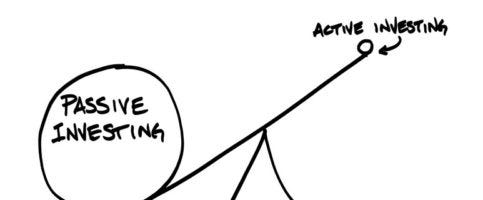
Bogle planted the seed for Vanguard when working on his Princeton thesis in 1951.
The Vanguard Group wasn’t founded until nearly 25 years later.
When the Vanguard 500 Index Fund was launched in 1976, it was met with criticism from many, “ridiculed by others in the industry as un-American and a sure path to mediocrity.”
By 1990, Vanguard had $55.8 billion in assets under management (AUM). $991.9 billion in 2005. $4.9 trillion at the time of Bogle’s death in 2019. Over $10.4 trillion today.
Bogle laughed the early skeptics to the bank as his unwavering commitment to low-cost, long-term index investing propelled Vanguard into one of the world’s largest asset management firms.
I use the Bogle example as a way to illustrate a clear picture of how the compound effect can play out tangibly.
Original criticism and skepticism. Little results to begin. The snowball starts to take shape. An avalanche ensues.
Keep in mind that it took Vanguard 18 years to achieve $100B in AUM. $200B came three years later.
In a marathon, the step that pushes you across the finish line is the one that brings jubilation. It is the one celebrated.
But the last step could not be completed without the first step.
And the tens of thousands in between.
All steps hold equal importance. Treat them as such.
“As you start to walk on the way, the way appears.” — Rumi
Love this Shane… so beautifully written!
Love the marathon comparison! It’s a great way to illustrate your important point.